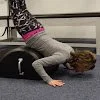
What happens to your posture in your 40s and 50s — and what actually helps
There's a moment a lot of people describe — usually sometime in their 40s or 50s — when they catch themselves in a photo or a mirror and think: when did that happen? A rounding of the upper back. A forward tilt to the head. A sense that they're not standing quite the way they used to.
It feels sudden. It isn't. These changes happen gradually, over years, driven by a combination of how we move (or don't), how we sit and the way the body naturally shifts as we age. What matters is that they're not fixed. And most people don't have to accept them.
What actually happens to posture as you age
From our 40s onwards, a few things start to shift. Bone density changes — particularly in women (think impending menopause). The discs between the vertebrae begin to lose some of their hydration and height. Muscle mass reduces if we're not actively maintaining it. The deep postural muscles — the ones that hold the spine long and supported — become less active if we're living in chairs and cars and desk-based routines.
The result is what you see in that photo. A rounding at the upper and mid back. A forward head position. Compressed breathing. And often, a steady low-level ache across the shoulders and lower back that people have come to think of as just part of getting older.
It isn't. Or at least — it doesn't have to be.
Why most approaches don't work
The instinct most people have is to stretch more, or to remind themselves to sit up straight. Neither of these addresses the real issue.
Stretching tight areas gives temporary relief, but if the muscles are tight because they're compensating for weaknesses elsewhere, they'll tighten again within hours. And willpower-based posture correction doesn't last. The body always returns to what feels habitual. If the deep supporting muscles aren't active enough to hold the spine well, you'll round again the moment you stop thinking about it.
What Classical Pilates does instead
Classical Pilates works from the inside out. The method builds the deep postural muscles — the ones that support the spine through its full length — through movement that is controlled and specific. Not by targeting isolated muscle groups, but by training the body to work as a connected system.
On the barrels and cadillac in particular, it's possible to work on extension — the opposite of rounding — in a way that's both safe and deeply effective. The apparatus provides support and feedback that you simply can't replicate on a mat alone initially. This is one of the reasons the full Classical system with proper equipment makes such a difference.
The change doesn't happen overnight. But it can happen. We see it in the studio regularly — clients who start noticing they're standing differently after a few months, who are told by their family that they look taller, who stop having that constant shoulder tension by the end of the day.
One client told us her friend noticed it before she did. "You are sitting differently." That's the kind of change that doesn't come from a weekend workshop. It comes from showing up consistently and doing the work.
It's not too late to start
We work with clients of all ages at Stourbridge Pilates Rooms. Some of our most committed practitioners started in their 50s and 60s. The method meets you where you are, and the progression is gradual and supported.
If you've been noticing postural changes and wondering what to do about them, this is a good place to start. Not because Pilates fixes everything — but because it addresses the right things, in the right way, for the right duration.
Ready to start?
Our £55 Intro to the Studio package includes a private one-to-one session, a reformer class and a mat class — everything you need to find your feet in the method at your own pace.